Femme à la mandoline
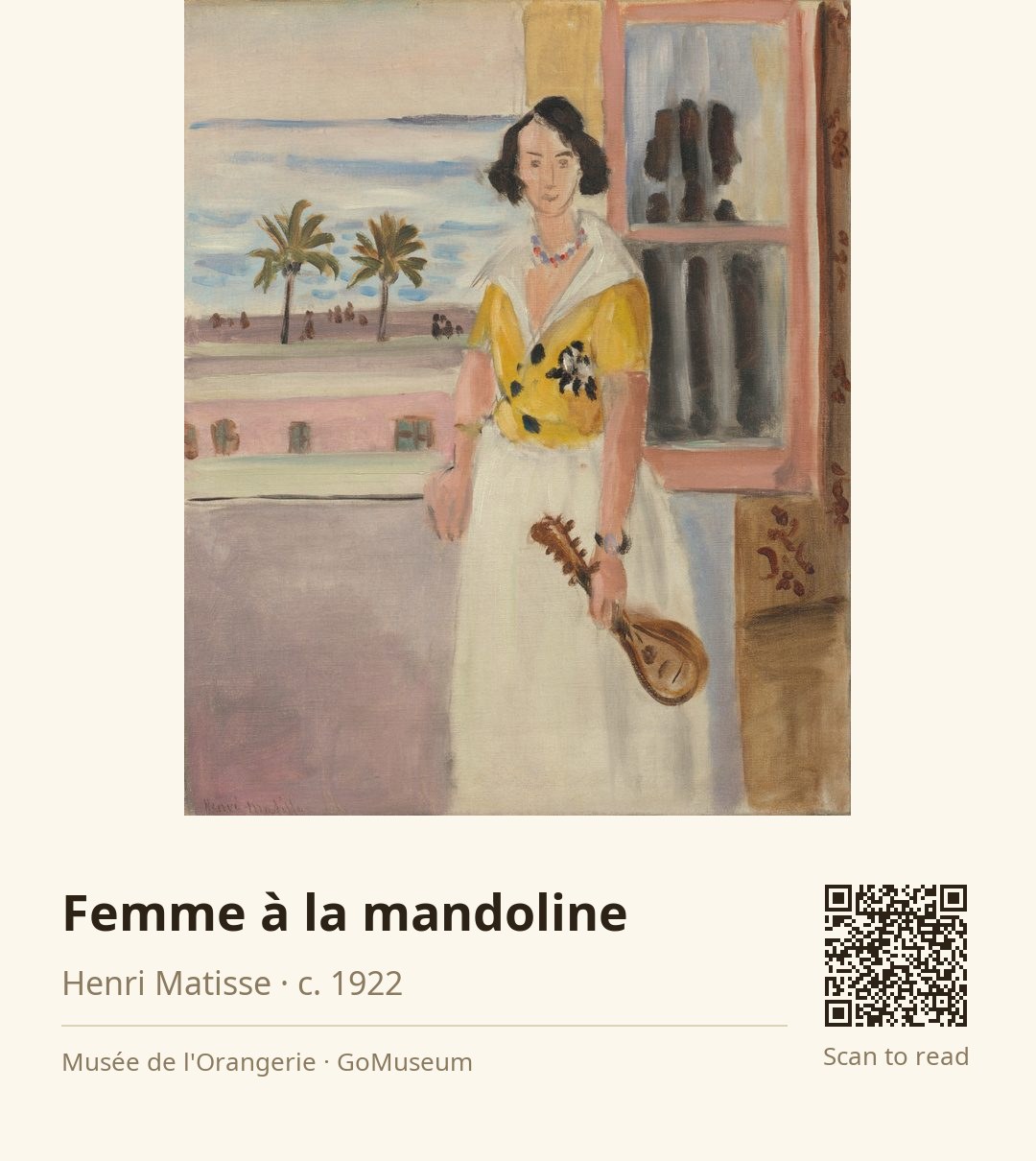
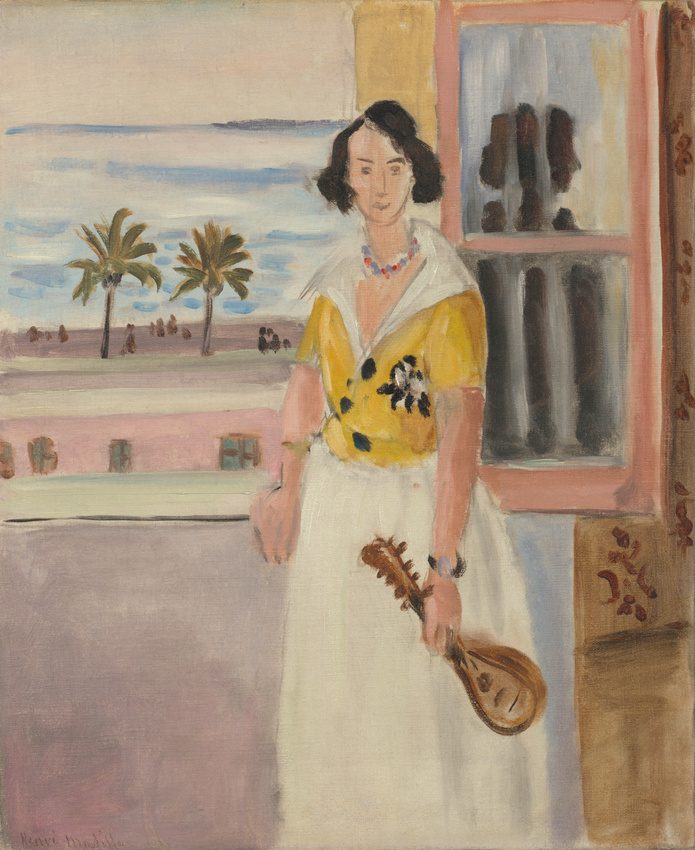
🎧 This work has audio narration — listen in the appThe woman in the yellow blouse, holding a mandolin, stands poised against a backdrop that opens up to the Mediterranean. Her vibrant outfit, adorned with black floral patterns, contrasts beautifully with the soft pastels of the scene, where blues and pinks evoke a warm coastal atmosphere. The window behind her frames a lively view of palm trees and figures enjoying the promenade, seamlessly blending the indoor and outdoor worlds.
This juxtaposition reflects Matisse's fascination with color and light, capturing not just a moment but a feeling of leisure and joy. The loose brushwork adds a sense of dynamism, as if the scene is alive with the sounds of music and laughter. Matisse's choice of a woman as the central figure, confidently holding her instrument, speaks to themes of femininity and artistic expression, inviting viewers to consider the interplay between the artist and their muse.
Created around 1922, "Femme à la mandoline" showcases Matisse's distinctive style during a period marked by experimentation and bold color choices. The painting was later exhibited in 1931 at the Kunsthalle in Basel, highlighting its significance in the artist's oeuvre.
Henri Matisse was a pioneering French artist born on December 31, 1869, in Le Cateau-Cambrésis. Initially studying law, he turned to art during a period of convalescence, discovering a passion that would lead him to become one of the most influential figures in modern art. Matisse's vibrant use of color and innovative forms defined the Fauvist movement, earning him recognition alongside contemporaries like Pablo Picasso.
His early works, characterized by traditional still lifes and landscapes, evolved dramatically after exposure to Impressionism and the color theories of John Russell. Matisse's style matured in the early 1900s, marked by bold colors and flattened forms. His relocation to Nice in 1917 ushered in a more relaxed aesthetic, blending classical influences with modern sensibilities.
Despite facing health challenges later in life, Matisse continued to innovate, creating significant cut paper collages. His mastery of color and form left an indelible mark on the art world, influencing generations of artists and solidifying his legacy as a central figure in 20th-century art history. Matisse passed away on November 3, 1954, leaving behind a rich body of work that continues to inspire.
Henri Matisse's 'Femme à la mandoline' was created around 1922 during a vibrant period of his artistic journey. This painting was part of a significant moment in Matisse's career, reflecting his bold exploration of color and form. It was first exhibited in 1931 at the Kunsthalle in Basel, where it was assigned the number 38 in the exhibition catalog. The provenance of the work traces back to several notable collectors, including Gaston Bernheim-Jeune and Paul Guillaume, both of whom were influential figures in the art world of the early 20th century.
In 'Femme à la mandoline', Matisse employs a loose and expressive brushwork that breathes life into the scene. The vibrant yellow of the woman's blouse, adorned with black floral patterns, pops against the softer pastels of the background. This choice of color not only draws your eye to the figure but also creates a sense of warmth and joy that permeates the painting. Matisse’s technique of layering colors adds depth and dimension, while the fluidity of the brushstrokes evokes a feeling of movement, as if the scene is alive with the sounds of music and laughter. The composition cleverly balances the indoor setting with the outdoor view, inviting the viewer to experience both spaces simultaneously.
Its first exhibition in 1931 at the Kunsthalle in Basel marked an important moment in its history, as it was cataloged as number 38, highlighting its significance in Matisse's body of work.
Matisse employed a technique of layering colors that creates depth and dimension, along with fluid brushstrokes that convey a sense of movement and vibrancy in the scene.