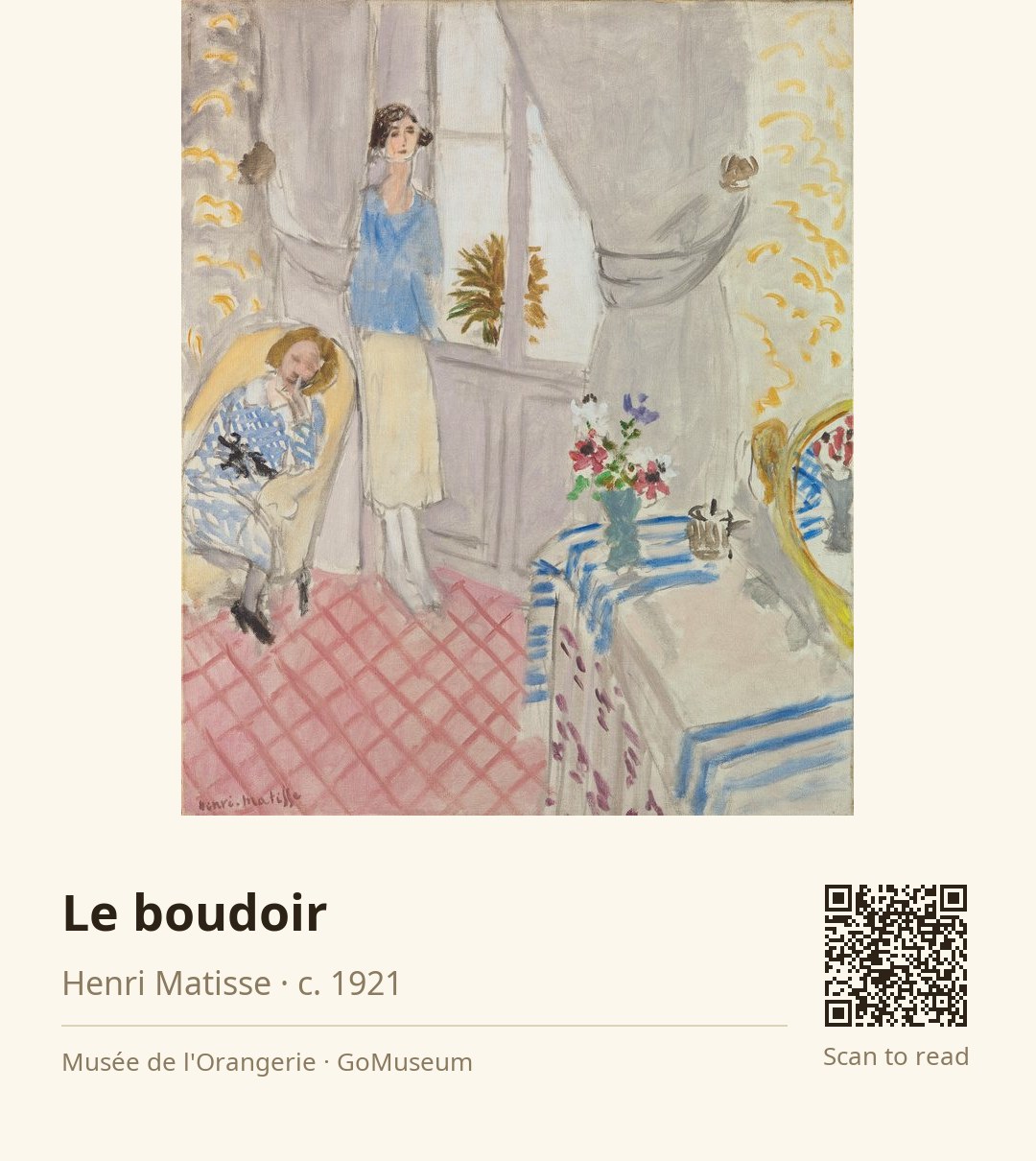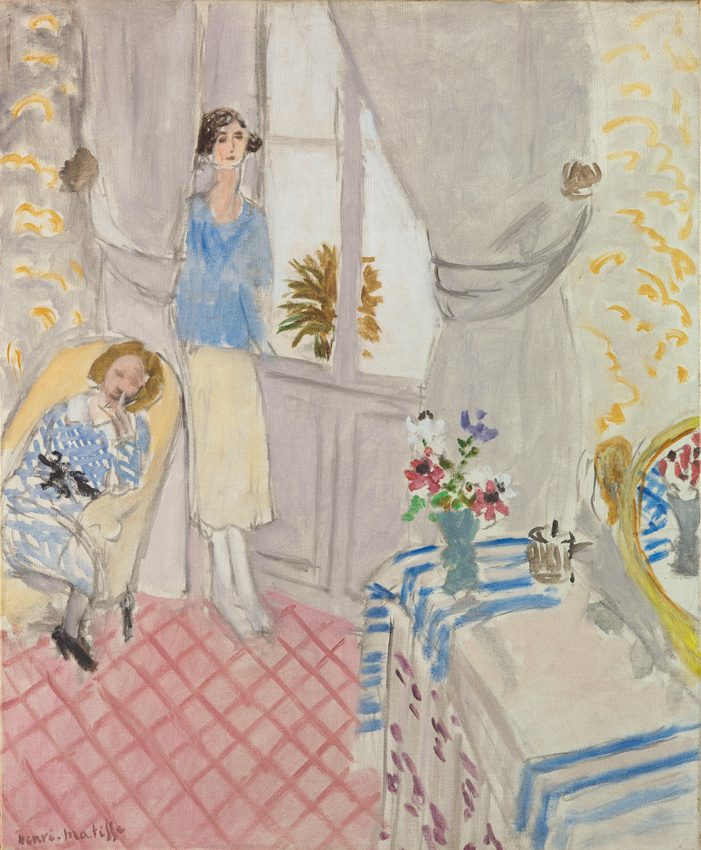
The figure in the patterned blue and white garment, slumped in a chair, captures a moment of serene repose in Matisse's "Le boudoir." Nearby, another figure stands by the window, dressed in a blue top and light skirt, framed by soft gray curtains that let in a glimpse of the foliage outside. The red and pink checkered floor adds a vibrant contrast to the pastel tones that dominate this intimate interior scene.
This composition reveals Matisse's mastery in creating a harmonious balance between figures and objects, inviting viewers into a tranquil domestic space. The choice of colors and patterns reflects his evolving style in the early 1920s, where he began to emphasize decorative elements and simplified forms. The presence of the flowers in the vase on the table not only adds a touch of life but also underscores Matisse's fascination with color as a subject in itself, a hallmark of his work during this period.
Created around 1921, "Le boudoir" exemplifies Matisse's shift towards a more relaxed and classical approach to painting, following his relocation to the French Riviera.
Henri Matisse was a pioneering French artist born on December 31, 1869, in Le Cateau-Cambrésis. Initially studying law, he turned to art during a period of convalescence, discovering a passion that would lead him to become one of the most influential figures in modern art. Matisse's vibrant use of color and innovative forms defined the Fauvist movement, earning him recognition alongside contemporaries like Pablo Picasso.
His early works, characterized by traditional still lifes and landscapes, evolved dramatically after exposure to Impressionism and the color theories of John Russell. Matisse's style matured in the early 1900s, marked by bold colors and flattened forms. His relocation to Nice in 1917 ushered in a more relaxed aesthetic, blending classical influences with modern sensibilities.
Despite facing health challenges later in life, Matisse continued to innovate, creating significant cut paper collages. His mastery of color and form left an indelible mark on the art world, influencing generations of artists and solidifying his legacy as a central figure in 20th-century art history. Matisse passed away on November 3, 1954, leaving behind a rich body of work that continues to inspire.
Created around 1921, 'Le boudoir' was exhibited at the Kunsthalle in Basel in 1931 and later at the Galerie Charpentier in Paris in 1944. The painting was part of the collection of Guillaume Paul in 1929 and later belonged to Walter Mme Vve Jean. Its inventory number is RF 1963-64.
The painting presents a cozy interior scene, where the seated figure on the left, draped in a patterned blue and white garment, appears to be in a peaceful slumber. To the right, the standing figure near the window, dressed in a blue top and light skirt, adds a sense of life to the space. The light gray curtains frame the window, allowing a glimpse of the greenery outside, while the vibrant red and pink checkered floor contrasts beautifully with the soft pastel tones that dominate the scene. The table in the foreground, adorned with a cloth featuring blue stripes, holds a vase filled with colorful flowers, enhancing the tranquil atmosphere of this intimate setting.
John Russell introduced Matisse to Impressionism and the work of Vincent van Gogh, which led Matisse to abandon his earth-toned palette for bright colors.
Matisse significantly influenced both figurative and abstract artists in the latter half of the 20th century through his innovative use of simplification, stylization, and color.