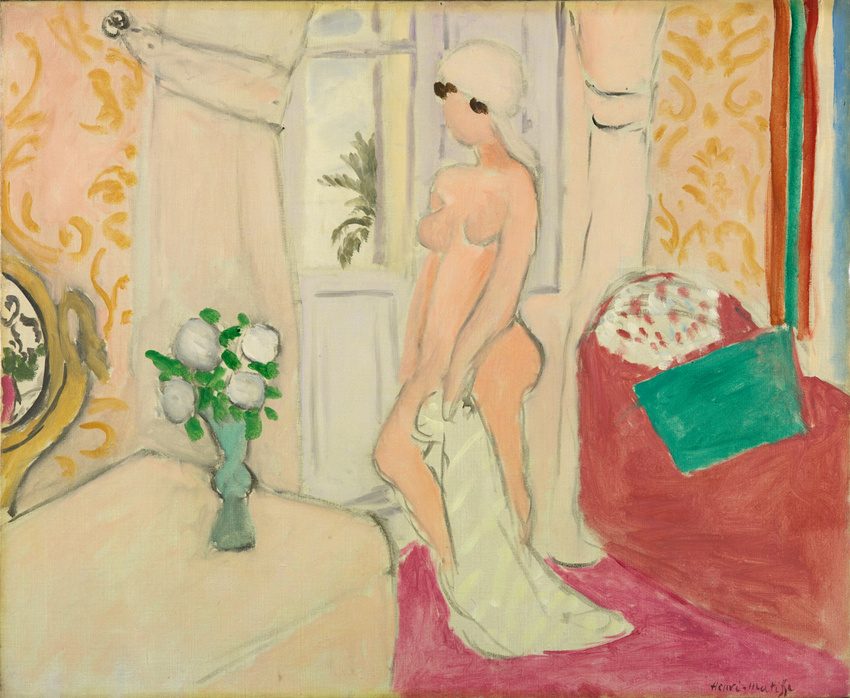
La jeune fille et le vase de fleurs
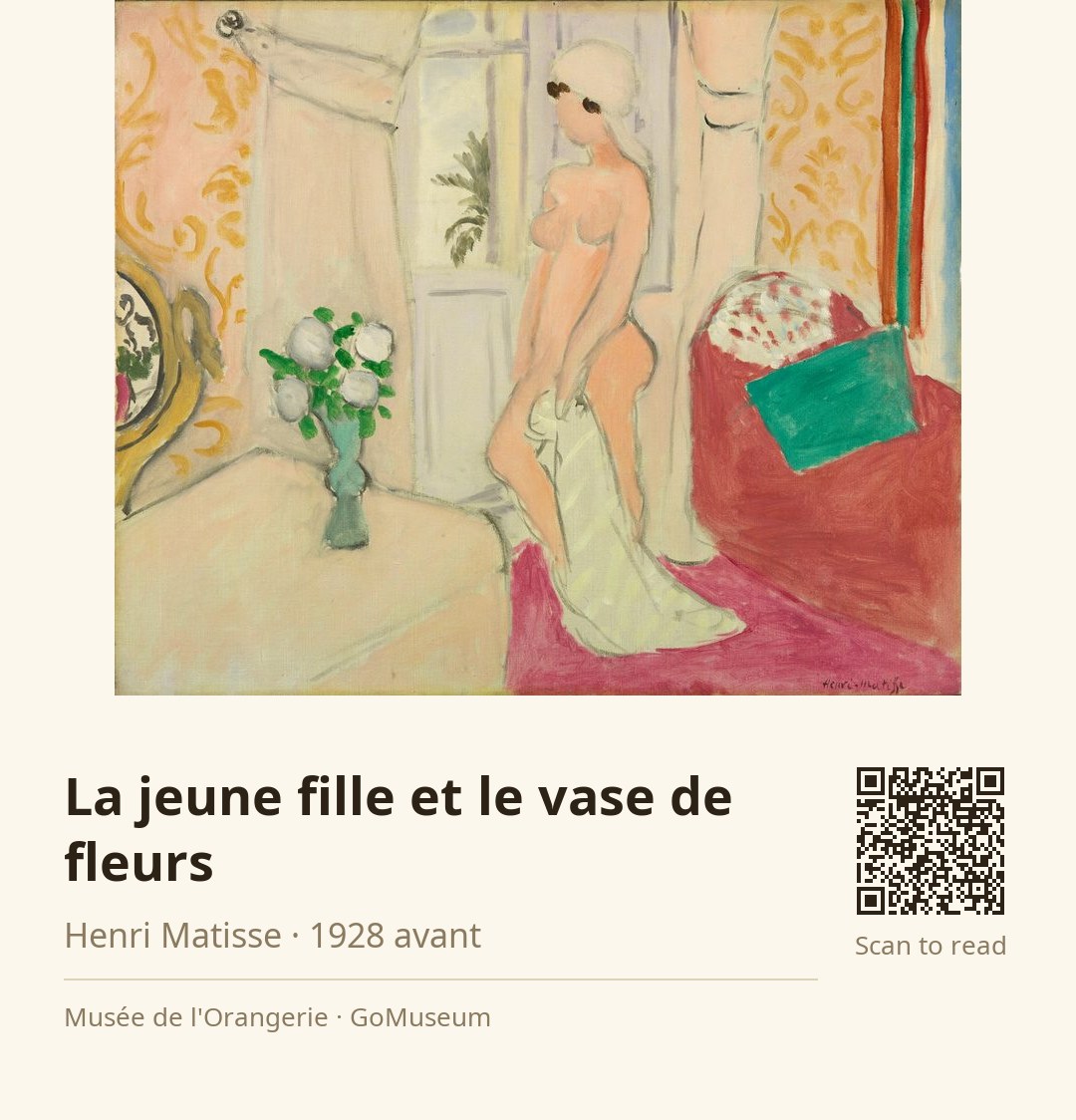
🎧 This work has audio narration — listen in the appThe nude woman in "La jeune fille et le vase de fleurs" stands gracefully in a sunlit room, her figure framed by a vibrant yellow wallpaper that envelops the space. In her right hand, she delicately holds a white cloth, while a vase of white flowers rests on a nearby table, adding a touch of life to the scene.
This juxtaposition of the soft pastels—pinks, yellows, and greens—against the bold patterns creates a sense of harmony and fluidity, characteristic of Matisse's style. The loose brushwork invites viewers into an intimate moment, capturing not just the physical presence of the woman but also the atmosphere of the room. Matisse's ability to blend color and form reflects his mastery of expressive painting, which was pivotal in the evolution of modern art.
Created in 1928, this work showcases Matisse's transition into a more relaxed style, which he developed during his time in Nice, where he sought to uphold the classical traditions of French painting. "La jeune fille et le vase de fleurs" was exhibited at the Galerie Bernheim-Jeune in Paris in 1929, marking a significant moment in Matisse's career as he continued to influence the trajectory of 20th-century art.
Henri Matisse was a pioneering French artist born on December 31, 1869, in Le Cateau-Cambrésis. Initially studying law, he turned to art during a period of convalescence, discovering a passion that would lead him to become one of the most influential figures in modern art. Matisse's vibrant use of color and innovative forms defined the Fauvist movement, earning him recognition alongside contemporaries like Pablo Picasso.
His early works, characterized by traditional still lifes and landscapes, evolved dramatically after exposure to Impressionism and the color theories of John Russell. Matisse's style matured in the early 1900s, marked by bold colors and flattened forms. His relocation to Nice in 1917 ushered in a more relaxed aesthetic, blending classical influences with modern sensibilities.
Despite facing health challenges later in life, Matisse continued to innovate, creating significant cut paper collages. His mastery of color and form left an indelible mark on the art world, influencing generations of artists and solidifying his legacy as a central figure in 20th-century art history. Matisse passed away on November 3, 1954, leaving behind a rich body of work that continues to inspire.
Created in 1928, 'La jeune fille et le vase de fleurs' was exhibited at the Galerie Bernheim-Jeune in Paris in 1929. The painting was acquired by Paul Guillaume in the same year it was created, establishing its provenance early on.
The painting features a nude woman standing in an interior, framed by vibrant yellow wallpaper that creates a striking backdrop. She holds a white cloth in her right hand, while a table to her left displays a vase of white flowers, adding a touch of life to the scene. The room's decor includes a red carpet and a mirror that reflects part of the space. The palette is dominated by soft pastels—pinks, yellows, and greens—that harmonize beautifully. Matisse's loose and expressive brushwork contributes to a sense of fluidity, inviting you into this intimate moment.
Interestingly, the painting is also known by another title, 'le nu rose,' which adds an extra layer to its identity in the art world.
'La jeune fille et le vase de fleurs' is also known as 'le nu rose,' which provides it with an additional identity in the art community.
Matisse's skill in combining color and form was crucial in shaping the development of modern art, showcasing his innovative approach to expressive painting.