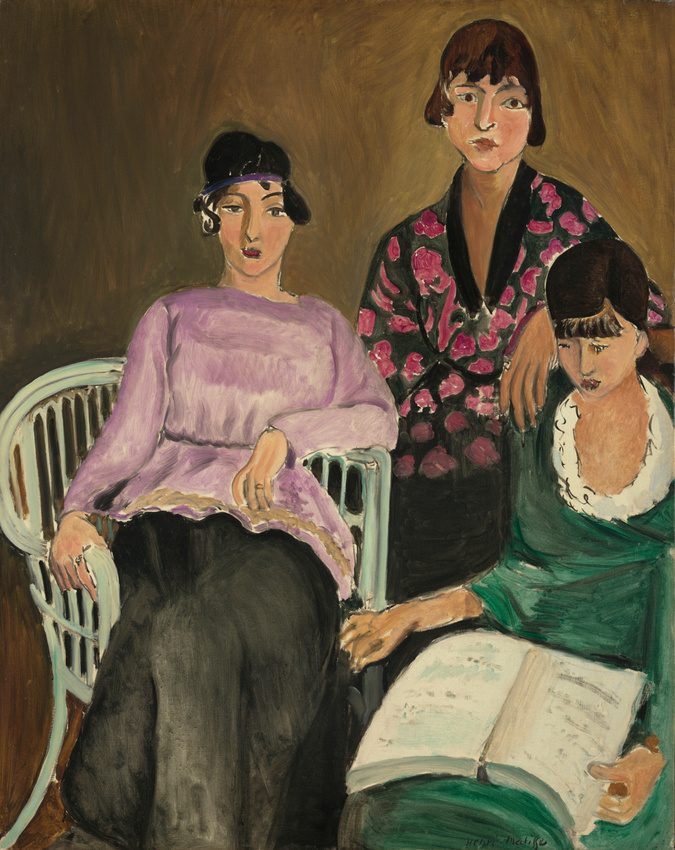
Les trois soeurs
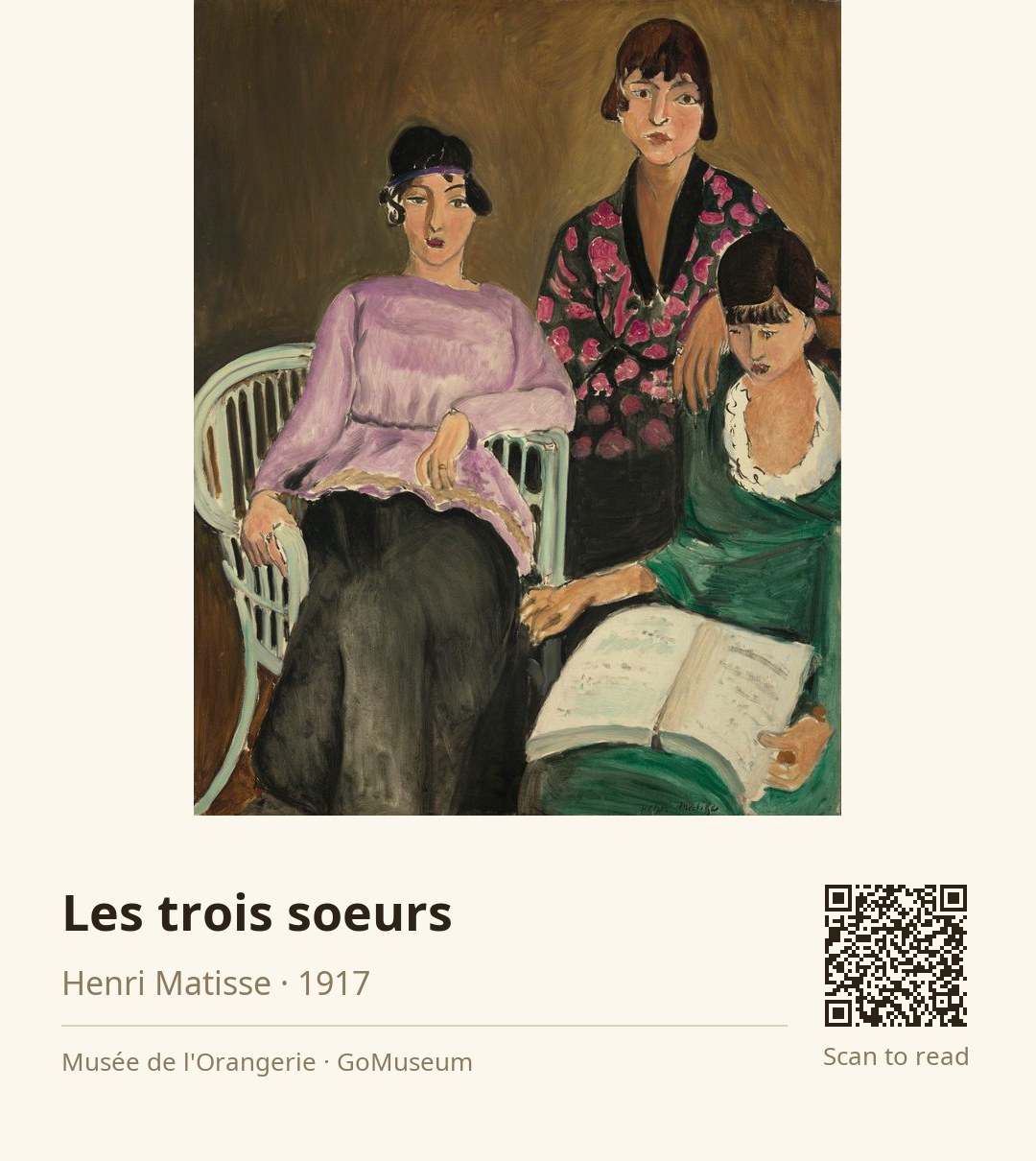
🎧 This work has audio narration — listen in the appThree women occupy a cozy interior in Matisse's "Les trois soeurs," each distinct yet harmoniously intertwined. The woman on the left, draped in a lavender blouse and black skirt, exudes a relaxed demeanor, while the central figure, adorned in a striking black dress with pink flowers, holds a calm gaze that draws you in. To the right, another sister, dressed in green with a white collar, is absorbed in the book resting on her lap, creating a moment of quiet reflection amidst the vibrant colors.
This composition captures a slice of life, showcasing the intimate bond between the sisters as they share a space filled with warmth and color. Matisse's loose brushwork enhances the liveliness of their clothing, allowing the viewer to appreciate the textures and hues that define their personalities. The warm brown background envelops the figures, creating a sense of unity and comfort, inviting you to linger in their world.
Created in 1917, this painting reflects Matisse's exploration of domestic life and the relationships that flourish within it, emphasizing the beauty of everyday moments. The work was part of a significant exhibition history, including displays at the Exposition universelle in Paris in 1937.
Henri Matisse was a pioneering French artist born on December 31, 1869, in Le Cateau-Cambrésis. Initially studying law, he turned to art during a period of convalescence, discovering a passion that would lead him to become one of the most influential figures in modern art. Matisse's vibrant use of color and innovative forms defined the Fauvist movement, earning him recognition alongside contemporaries like Pablo Picasso.
His early works, characterized by traditional still lifes and landscapes, evolved dramatically after exposure to Impressionism and the color theories of John Russell. Matisse's style matured in the early 1900s, marked by bold colors and flattened forms. His relocation to Nice in 1917 ushered in a more relaxed aesthetic, blending classical influences with modern sensibilities.
Despite facing health challenges later in life, Matisse continued to innovate, creating significant cut paper collages. His mastery of color and form left an indelible mark on the art world, influencing generations of artists and solidifying his legacy as a central figure in 20th-century art history. Matisse passed away on November 3, 1954, leaving behind a rich body of work that continues to inspire.
Henri Matisse's 'Les trois soeurs' was created in 1917, a pivotal time in his career when he was deeply engaged in exploring domestic life. This painting was commissioned by the art dealer Paul Guillaume, who played a crucial role in promoting Matisse's work. The painting first appeared in public at the 1929 exhibition 'La grande peinture contemporaine' in Paris, showcasing it alongside other modern masters. Over the years, it traveled through various exhibitions, including the notable Exposition universelle in 1937, where it was displayed among the greats of independent art. Its provenance traces back to notable collectors like Auguste Pellerin, who sold it in a 1926 auction, and it eventually found its way into the hands of other esteemed patrons.
In 'Les trois soeurs', Matisse employs a loose, expressive brushwork that breathes life into the figures and their surroundings. The vibrant colors are not just for show; they evoke emotion and intimacy, drawing you into the sisters' world. The central figure, adorned in a striking black dress with pink flowers, stands out against the warm brown background, which envelops the scene and creates a sense of unity. Matisse's choice of scale—92 by 73 centimeters—allows for a close-up view that enhances the personal connection with the subjects. The way he handles the paint, with thick, confident strokes, gives texture to the clothing, making the fabric almost palpable.
'Les trois soeurs' was first publicly exhibited in 1929 at 'La grande peinture contemporaine' in Paris, marking its introduction to a wider audience.