 Image: Francesco Bini
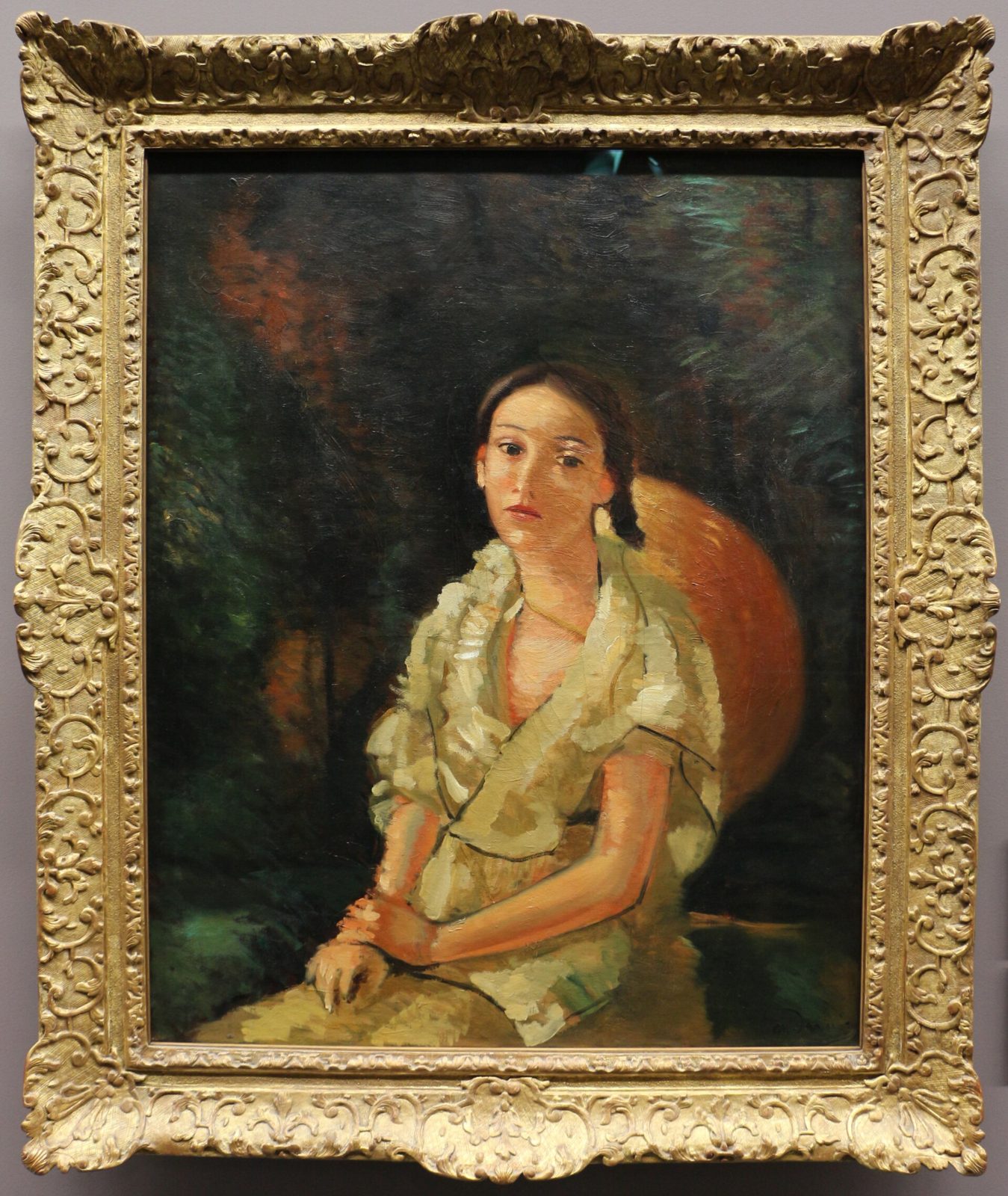
La nièce du peintre assise
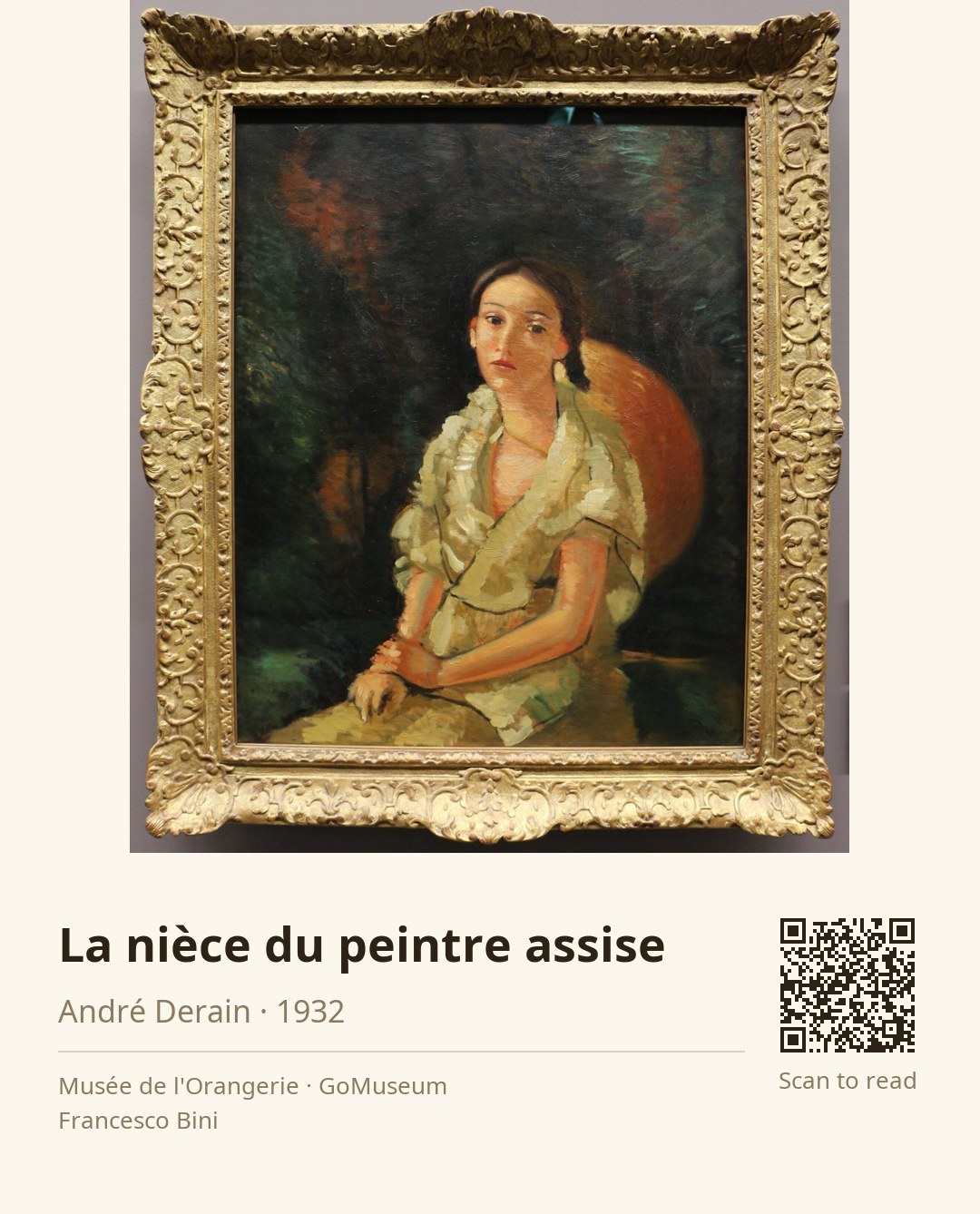
🎧 This work has audio narration — listen in the appGeneviève Taillade sits in a moment of quiet contemplation, her gaze meeting yours with an intensity that draws you in. Dressed in a light-colored garment that flows softly around her, the texture of her attire contrasts beautifully with the dark greens and browns of the background, which hints at a natural setting. The loose brushwork adds a dynamic quality, making her figure stand out against the darker tones, emphasizing her expression and inviting a connection.
Created in 1932, André Derain's "La nièce du peintre assise" captures not just a portrait but a fleeting moment in time, where the subject's stillness speaks volumes. The artist's choice of colors and brush technique reflects the emotional depth of the scene, allowing the viewer to feel the weight of her thoughts. Derain, a key figure in the Fauvist movement, often explored the interplay of color and form, and here, he masterfully uses these elements to create a sense of intimacy.
This painting was exhibited in notable venues, including the Durand-Ruel Gallery in New York in 1933 and the World Fair in 1939, showcasing its significance in the context of 20th-century art.
André Derain was a pivotal French artist born on June 17, 1880, in Chatou, near Paris. He co-founded the Fauvist movement alongside Henri Matisse, known for its bold use of color and expressive brushwork. Derain's early works from 1905-1906 showcased vibrant hues that challenged traditional aesthetics, earning the moniker "les Fauves" or "the wild beasts." His time in London further evolved his style, where he produced a series of striking paintings that captured the essence of the city with innovative techniques.
After World War I, Derain shifted towards a more classical approach, influenced by the Old Masters and a desire for order in art. This transition marked his emergence as a leader in the renewed classicism movement, where he combined his theatrical interests with visual arts. Despite facing criticism post-war, he remained a significant figure in the interwar period, contributing to ballet and theater design.
Derain's legacy is marked by his ability to bridge movements, from Fauvism to classicism, leaving an indelible mark on 20th-century art. He passed away on September 8, 1954, remembered as a complex artist who navigated the tumultuous changes of his time.
André Derain's 'La nièce du peintre assise' was created in 1932, during a vibrant period for the artist, who was deeply entrenched in the Fauvist movement. This painting, featuring Geneviève Taillade, was exhibited shortly after its completion at the Durand-Ruel Gallery in New York in 1933, where it was listed as number 7 in the exhibition. It also appeared in the Brummer Gallery in 1936 and was part of the World Fair in New York in 1939, showcasing its appeal and importance in the evolving art scene. The painting has a rich provenance, having passed through the hands of notable collectors like Guillaume Paul and Walter Mme Vve Jean, which speaks to its desirability and significance in the art market.
Derain's technique in 'La nièce du peintre assise' is a striking display of loose brushwork that brings a sense of immediacy to the painting. The visible strokes create a textured surface, allowing the viewer to feel the energy of the moment captured. The choice of a light-colored garment for Geneviève contrasts sharply with the dark greens and browns of the background, not just highlighting her figure but also enhancing the emotional weight of her contemplative expression. The composition, with Geneviève slightly turned towards the viewer, invites a connection, while the scale of the painting—nearly 97 by 78 centimeters—allows for an immersive experience, drawing you into her world.
The painting was owned by notable collectors such as Guillaume Paul and Walter Mme Vve Jean, indicating its desirability in the art market.
The painting was exhibited at the Durand-Ruel Gallery in New York in 1933 and later at the World Fair in 1939, highlighting its importance in 20th-century art.