 Image: Francesco Bini
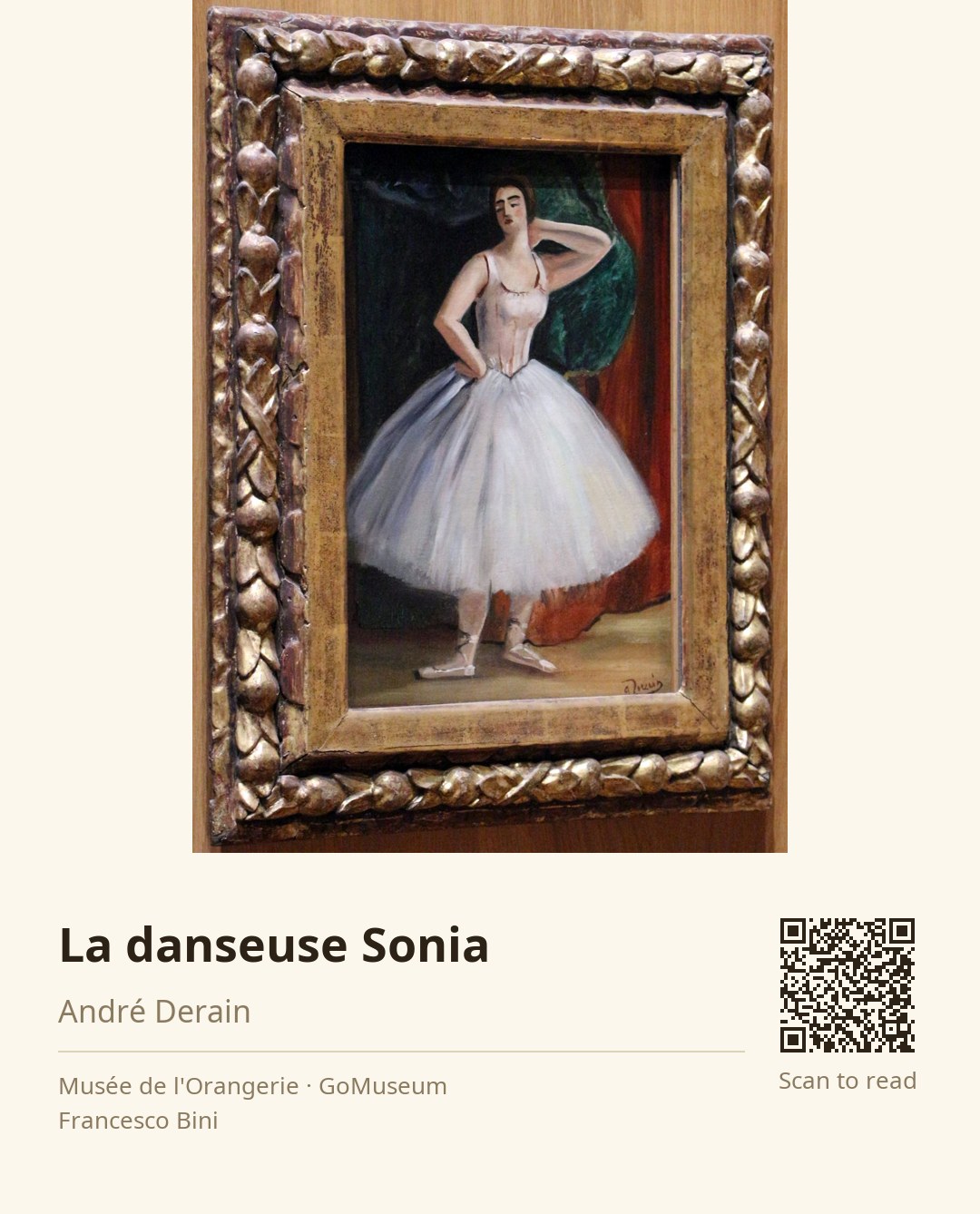
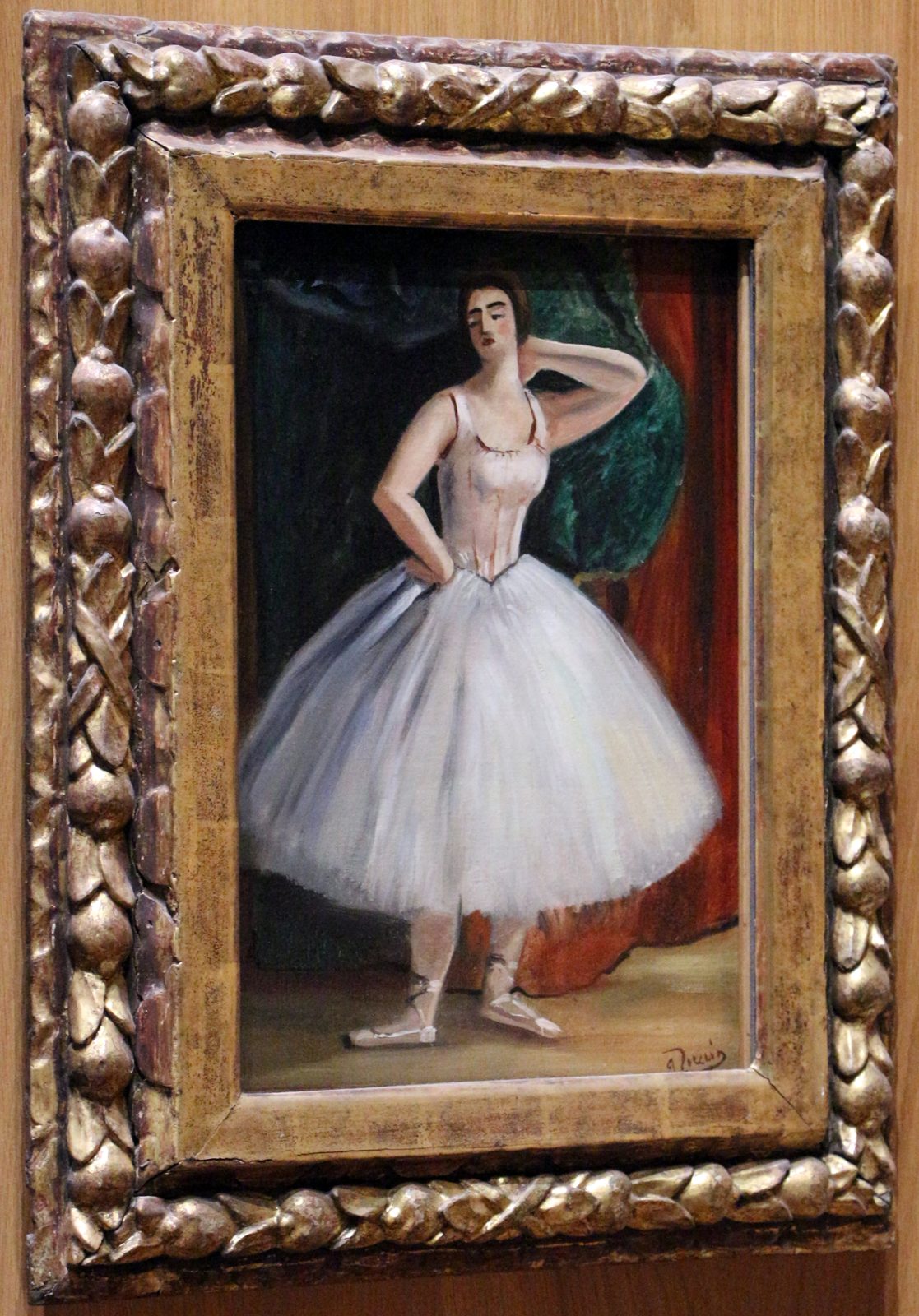
La danseuse Sonia
🎧 This work has audio narration — listen in the appThe poised ballerina in "La danseuse Sonia" captures a moment of elegance and grace, her white tutu contrasting beautifully against the dark green curtain behind her. With her left hand resting confidently on her hip and her right arm gracefully touching her head, she embodies the essence of ballet, her calm expression inviting you into her world.
The smooth brushwork enhances the delicate texture of her tutu, while the muted earth tones create a serene atmosphere that highlights her form. This composition centers the dancer, drawing your eye to her poised stance and the subtle play of light across her figure. The background hints at a stage setting, suggesting the anticipation of performance and the artistry of dance.
Painted by André Derain in the early 20th century, this work reflects a period when artists were exploring new forms of expression, merging traditional subjects with modern techniques. Derain's choice of a ballet dancer as his subject speaks to the cultural significance of dance in that era, capturing not just a figure, but the spirit of performance itself.
André Derain was a pivotal French artist born on June 17, 1880, in Chatou, near Paris. He co-founded the Fauvist movement alongside Henri Matisse, known for its bold use of color and expressive brushwork. Derain's early works from 1905-1906 showcased vibrant hues that challenged traditional aesthetics, earning the moniker "les Fauves" or "the wild beasts." His time in London further evolved his style, where he produced a series of striking paintings that captured the essence of the city with innovative techniques.
After World War I, Derain shifted towards a more classical approach, influenced by the Old Masters and a desire for order in art. This transition marked his emergence as a leader in the renewed classicism movement, where he combined his theatrical interests with visual arts. Despite facing criticism post-war, he remained a significant figure in the interwar period, contributing to ballet and theater design.
Derain's legacy is marked by his ability to bridge movements, from Fauvism to classicism, leaving an indelible mark on 20th-century art. He passed away on September 8, 1954, remembered as a complex artist who navigated the tumultuous changes of his time.
Commissioned by the prominent art dealer Paul Guillaume in 1929, this painting was part of a collection that showcased contemporary art. It first made waves at the 'La grande peinture contemporaine' exhibition held at the Bernheim-Jeune gallery in Paris that same year. The painting later appeared in the 1948 exhibition 'Danse et Divertissement' at the Charpentier gallery, further solidifying its place in the art scene. Over the years, 'La danseuse Sonia' has passed through various hands, including the collection of Walter Mme Vve Jean, showcasing its enduring appeal and significance in the art world.
In 'La danseuse Sonia', Derain employs a smooth brushwork technique that brings a sense of fluidity to the ballerina's form. The oil paint is layered with precision, allowing for a delicate texture that mimics the softness of her tutu. The muted earth tones create a harmonious backdrop, while the contrasting white of the dancer's attire draws your eye immediately to her poised figure. The composition is masterfully centered, with the ballerina's stance commanding attention. Derain's choice of a dark green curtain, accented with hints of red, not only frames the dancer but also evokes the atmosphere of a stage, suggesting both anticipation and performance. The subtle shading across her figure enhances the three-dimensional quality, making her appear almost lifelike, as if she might step off the canvas at any moment.