 Image: xiquinhosilva from Cacau
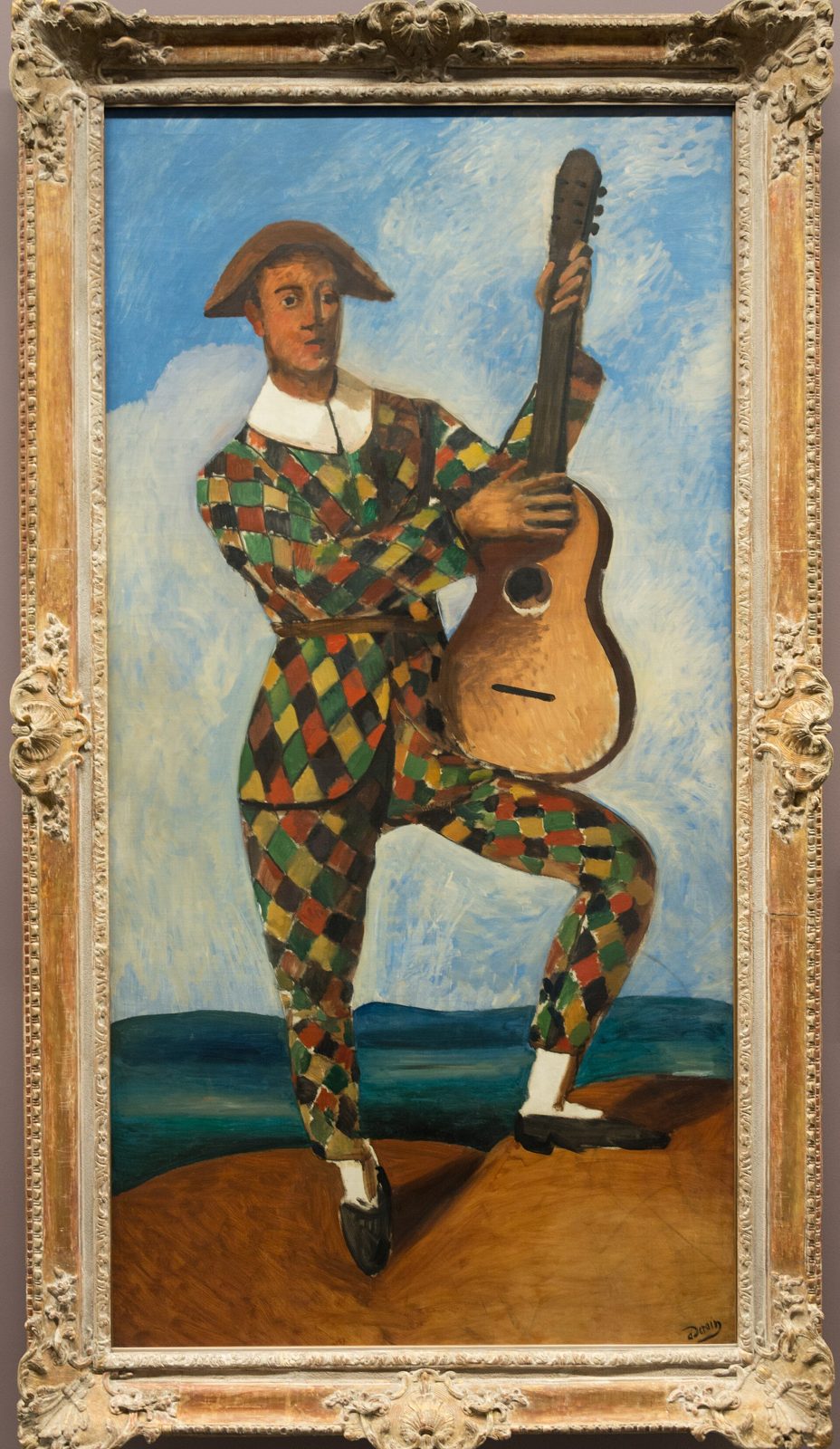
Arlequin à la guitare
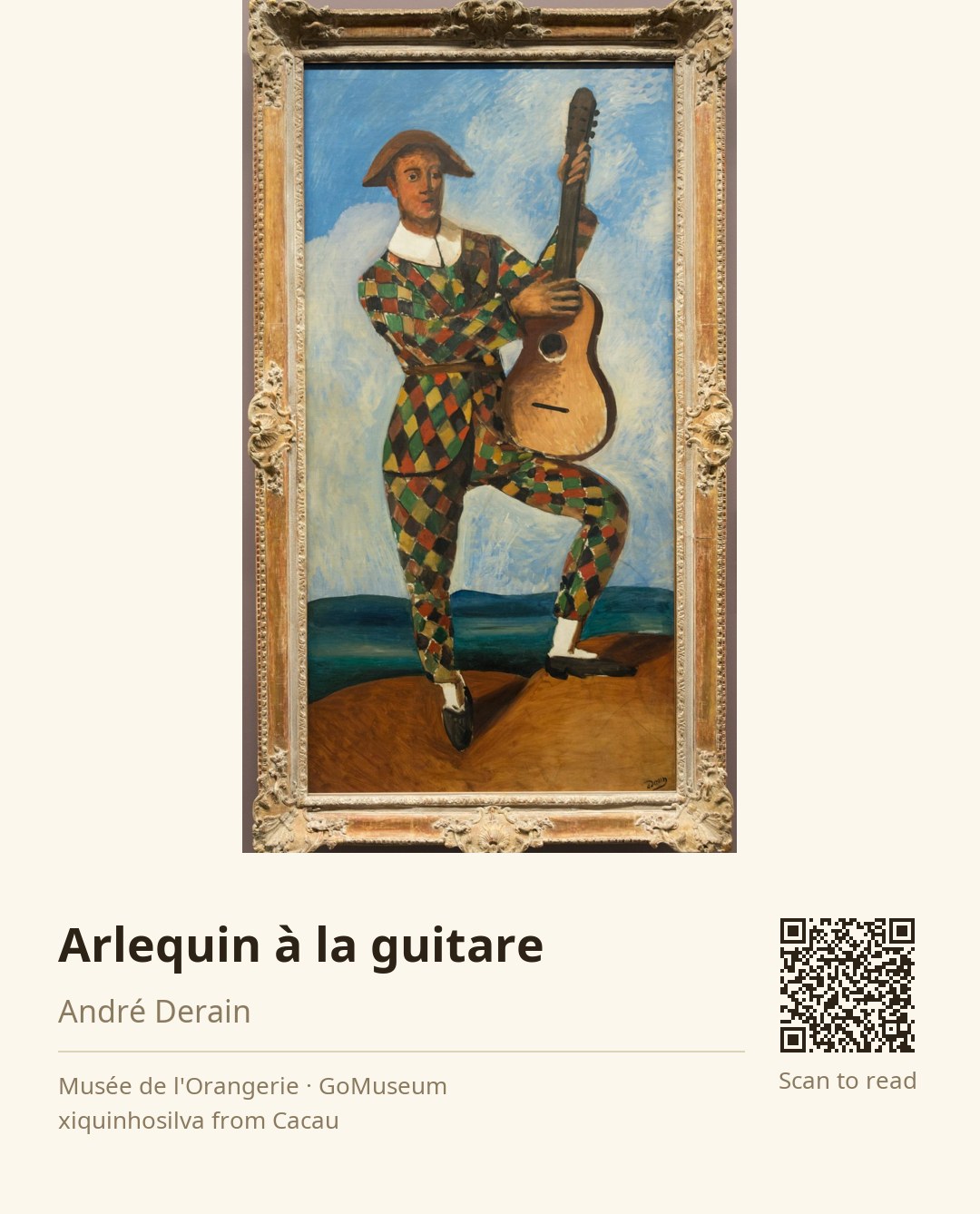
🎧 This work has audio narration — listen in the appThe vibrant harlequin in André Derain's "Arlequin à la guitare" captures your attention with its striking diamond-patterned costume, a lively mix of red, green, yellow, and black. Standing on one leg, the figure balances gracefully while holding a guitar, embodying both playfulness and poise. The wide-brimmed hat and neutral expression add an intriguing layer to this character, inviting you to ponder the story behind the pose.
Derain's brushwork brings the scene to life, with broad strokes that create a textured sky and landscape, suggesting a coastal setting. The simplicity of the background, featuring a serene body of water under a blue sky, contrasts with the dynamic figure, emphasizing the harlequin's role as the focal point. This composition, vertical in nature, draws your eye directly to the character, making it impossible to overlook the energy and whimsy he embodies.
Created in the early 20th century, this painting reflects Derain's exploration of color and form, showcasing his distinctive style that bridges traditional and modern influences. "Arlequin à la guitare" was part of exhibitions in Paris and New York, highlighting its significance in the evolution of contemporary art.
André Derain was a pivotal French artist born on June 17, 1880, in Chatou, near Paris. He co-founded the Fauvist movement alongside Henri Matisse, known for its bold use of color and expressive brushwork. Derain's early works from 1905-1906 showcased vibrant hues that challenged traditional aesthetics, earning the moniker "les Fauves" or "the wild beasts." His time in London further evolved his style, where he produced a series of striking paintings that captured the essence of the city with innovative techniques.
After World War I, Derain shifted towards a more classical approach, influenced by the Old Masters and a desire for order in art. This transition marked his emergence as a leader in the renewed classicism movement, where he combined his theatrical interests with visual arts. Despite facing criticism post-war, he remained a significant figure in the interwar period, contributing to ballet and theater design.
Derain's legacy is marked by his ability to bridge movements, from Fauvism to classicism, leaving an indelible mark on 20th-century art. He passed away on September 8, 1954, remembered as a complex artist who navigated the tumultuous changes of his time.
Commissioned by the notable art dealer Paul Guillaume in 1929, this piece quickly found its way into significant exhibitions. It debuted at the 'La grande peinture contemporaine' exhibition at the Galerie Bernheim-Jeune in Paris that same year, showcasing the vibrant energy of contemporary art. The painting later crossed the Atlantic, featured in the 'Ten Paintings by XXth Century French Masters' at the Valentine Gallery in New York in 1936. Its journey continued, appearing in various exhibitions, including a retrospective at the Musée National d'Art Moderne in Paris in 1954 and again at the Galerie Maeght in 1958.
The broad brushstrokes create a palpable texture, particularly in the sky and landscape, which contrast beautifully with the vibrant harlequin figure. The use of a vertical composition draws your eye upward, emphasizing the figure's dynamic pose. The colors are not merely decorative; they evoke emotion and energy, with the bold reds and greens clashing and harmonizing in a way that feels almost musical. The simplicity of the background, with its serene blue sky and calm water, serves to elevate the harlequin, making him the undeniable focal point. This choice of scale and composition invites the viewer to engage with the character's playful spirit, while the neutral expression adds an air of mystery, leaving you to wonder about the story behind the pose.
'Arlequin à la guitare' was included in the 'Ten Paintings by XXth Century French Masters' exhibition in New York in 1936, contributing to its international acclaim.
After its debut, the painting was showcased in a retrospective at the Musée National d'Art Moderne in 1954 and again at the Galerie Maeght in 1958.