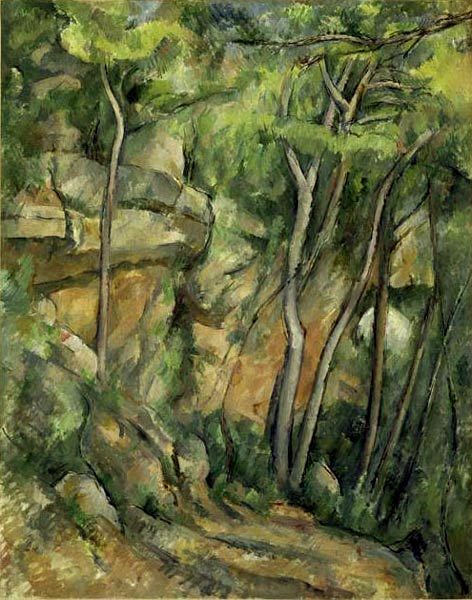
Dans le parc de Château Noir
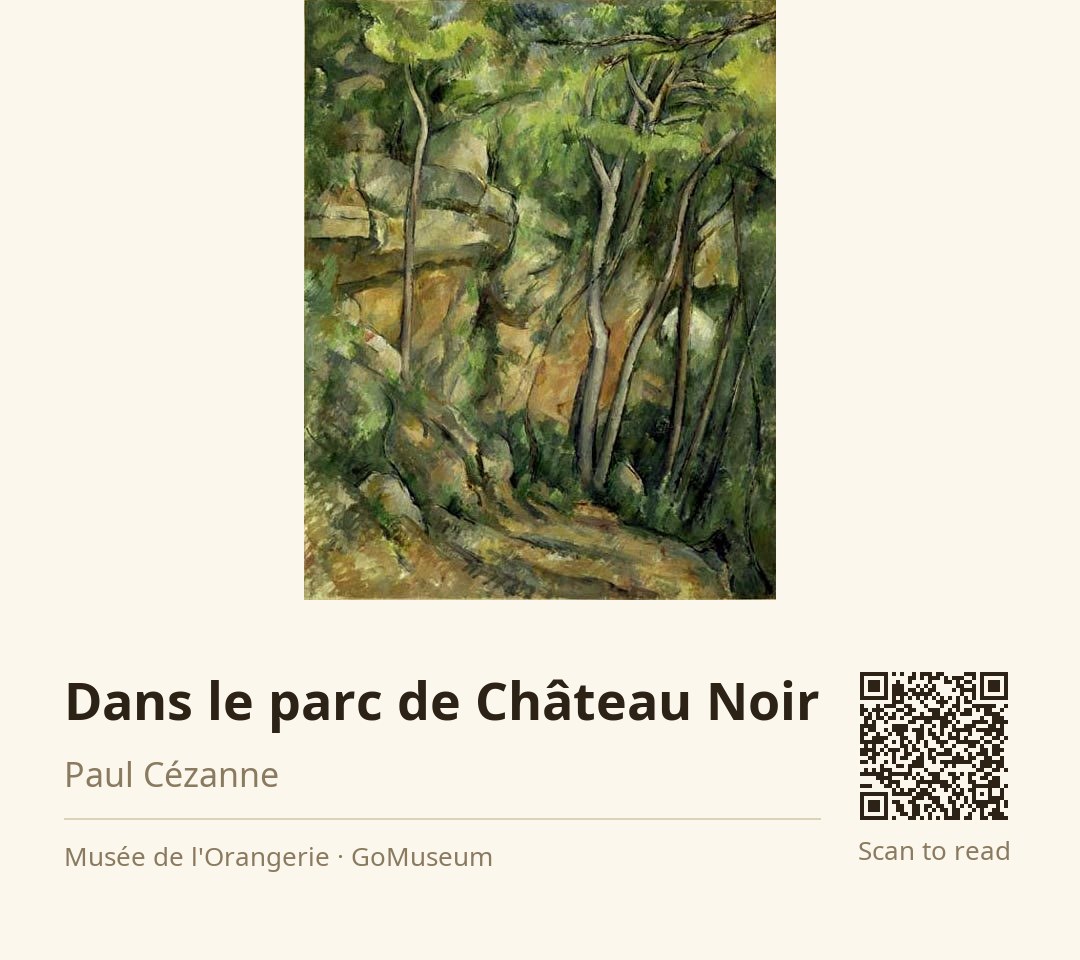
🎧 This work has audio narration — listen in the appThe tall, slender trees in the foreground of "Dans le parc de Château Noir" create a striking verticality that draws your eye upward, inviting you into the dense forest. Their thin trunks are surrounded by lush green foliage, while rugged rocky formations emerge in the middle distance, adding a sense of depth and texture to the scene.
Cézanne’s choice of a predominantly green and earthy palette not only captures the essence of the natural landscape but also reflects his unique approach to color, where subtle variations in tone suggest the interplay of light and shadow. The visible brushwork, with its loose and expressive strokes, brings the trees and rocks to life, allowing you to feel the tactile quality of the forest.
Painted in the late 19th century, this piece exemplifies Cézanne's evolving style as he sought to capture the essence of nature through a more abstract lens. The painting was part of several exhibitions in Paris, including one in 1939, showcasing its enduring significance in the art world.
Paul Cézanne was a French Post-Impressionist painter born on January 19, 1839, in Aix-en-Provence. His innovative approach to color and form bridged the gap between Impressionism and the emerging Cubism of the early 20th century. Initially influenced by Romanticism and Realism, Cézanne developed a unique style that emphasized the underlying structure of objects, using repetitive brushstrokes and planes of color to create depth and complexity in his work.
Despite facing ridicule and misunderstanding from critics during his early career, Cézanne garnered support from fellow artists like Camille Pissarro and the art dealer Ambroise Vollard, who recognized his talent. His first solo exhibition in 1895 marked a turning point, leading to greater appreciation of his contributions to art. Cézanne's legacy is profound; both Henri Matisse and Pablo Picasso acknowledged him as a foundational figure in modern art, dubbing him "the father of us all." He passed away on October 22, 1906, leaving behind a transformative body of work that continues to influence artists today.
In 'Dans le parc de Château Noir', Cézanne employs a technique that is both deliberate and expressive. The brushwork is loose yet controlled, allowing the viewer to feel the vibrancy of the forest. His use of color is particularly striking; the greens and earthy browns are not just a representation of nature but a reflection of his emotional response to the landscape. The vertical composition draws the eye upward, enhancing the sense of scale and depth. The rugged rocky formations are painted with a textured approach that contrasts with the smoothness of the foliage, creating a dynamic interplay between the elements. Cézanne’s layering technique, where he builds up paint in thick strokes, adds a tactile quality to the scene, inviting you to imagine the rough bark of the trees and the coolness of the rocks. This method captures not just the visual aspects of the forest but also its essence, making the viewer feel as if they are stepping into the natural world he so passionately depicted.
There is a notable contrast between the textured rocky formations and the smooth foliage, which creates a dynamic interaction between these elements in the artwork.