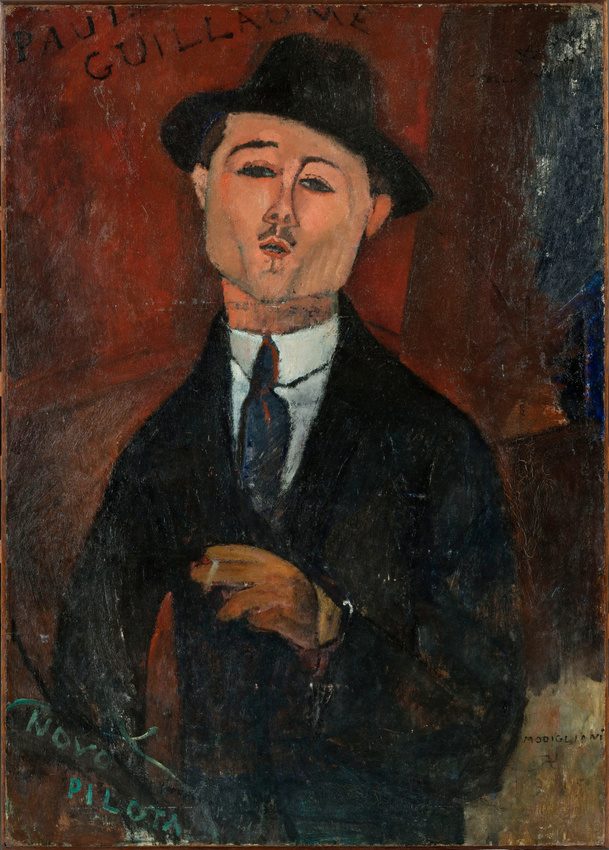
Portrait of Paul Guillaume
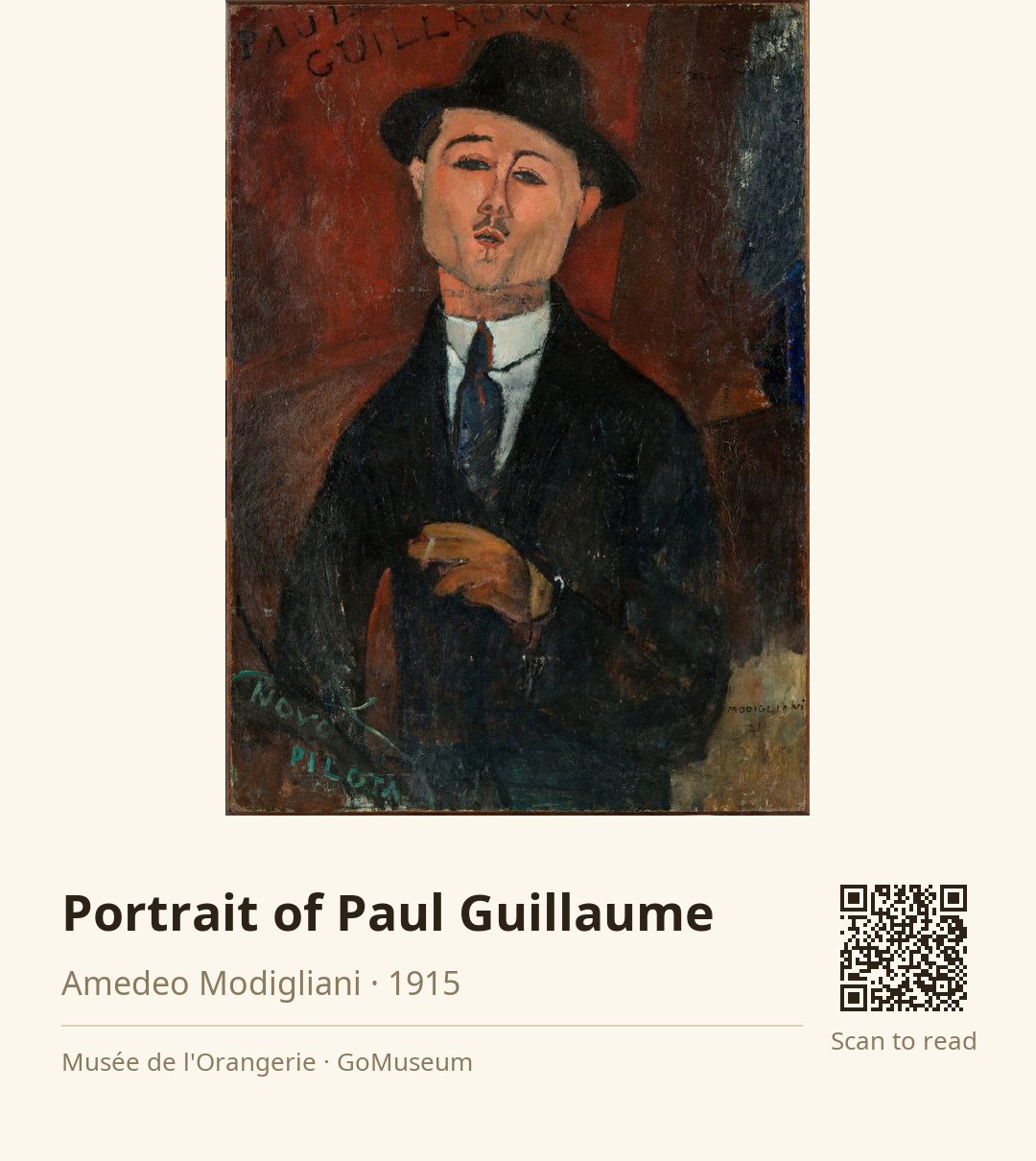
🎧 This work has audio narration — listen in the appTake a moment to really look at Modigliani’s "Portrait of Paul Guillaume." Notice the way the artist has elongated the neck and face of his subject, giving him an almost ethereal presence. The deep, rich colors of the background contrast beautifully with the lighter tones of Guillaume’s skin, drawing your eye right to his face.
These details matter because they reveal Modigliani’s unique style, which blends traditional portraiture with a modern twist. By stretching the features, he captures not just the likeness of Paul Guillaume, a prominent art dealer, but also something deeper—perhaps a sense of the soul or the essence of the man.
Created in 1915, during a tumultuous period in Modigliani’s life, this painting reflects his struggles and aspirations as an artist. Modigliani was known for his bohemian lifestyle in Paris, surrounded by other avant-garde artists, yet he often felt isolated and misunderstood.
As you stand here, think about the connection between the artist and his subject. What do you think Modigliani was trying to convey about Paul Guillaume? What emotions does this portrait evoke for you?
Amedeo Modigliani was an Italian painter and sculptor born on July 12, 1884, in Livorno, Italy. He grew up in a Sephardic Jewish family, which supported his artistic aspirations despite financial hardships. Modigliani moved to Paris in 1906, where he became part of the vibrant École de Paris, mingling with notable artists like Picasso and Brâncuși. His work is characterized by elongated forms and a unique modern style, focusing on portraits and nudes. Although he struggled for recognition during his lifetime, his art gained immense popularity posthumously. Modigliani's life was marked by health issues, including tuberculosis, which ultimately led to his early death at 35. His legacy is that of the "cursed artist," often romanticized due to his tumultuous life and the tragic suicide of his partner, Jeanne Hébuterne, after his death. Today, Modigliani is celebrated for his distinctive aesthetic and significant contributions to 20th-century art, bridging tradition and modernity.
In 1915, Amedeo Modigliani painted the 'Portrait of Paul Guillaume,' capturing the essence of the influential art dealer who was a significant figure in the Parisian art scene. This work was commissioned by Guillaume himself, and it's one of three portraits Modigliani created of him. The painting measures 105 by 75 centimeters and is rendered in oil on cardboard. Its journey through the art world began with its exhibition at the Grand Palais in Paris in 1926, part of the 'Trente ans d'art indépendant' show. Over the years, it has been displayed in numerous prestigious exhibitions, including the 1935 Paris exhibition and the 1937 Exposition Universelle. The painting eventually found its home at the Musée de l'Orangerie in Paris, where it continues to be celebrated. The provenance traces back to Paul Guillaume in 1925 and later to Madame Vve Jean Walter, highlighting its esteemed history and the recognition it garnered long after Modigliani's untimely death in 1920.
As you gaze at 'Portrait of Paul Guillaume,' pay attention to Modigliani's distinctive brushwork. The artist employs a smooth, almost fluid application of oil paint, creating a sense of depth and dimension while maintaining a flatness that is characteristic of his style. Notice how the elongated forms of Guillaume's face and neck draw your eye upward, emphasizing an ethereal quality. The rich, deep colors of the background contrast sharply with the lighter tones of Guillaume's skin, which not only highlights the subject but also evokes a sense of intimacy. Modigliani's choice to depict Guillaume in a frontal pose, with a direct gaze, invites you to connect with the subject on a personal level. The composition is structured yet free-flowing, allowing the viewer to feel the tension between the traditional portraiture and the modernist approach that Modigliani embodies. This technique creates an emotional resonance that lingers long after you've stepped away.
Struggling with health problems throughout his life, Modigliani's bouts with tuberculosis and pleurisy often forced him to work in bursts of creativity, which may have contributed to the urgency and emotional depth found in his portraits, including 'Portrait of Paul Guillaume'.