The Water Lilies - The Two Willows
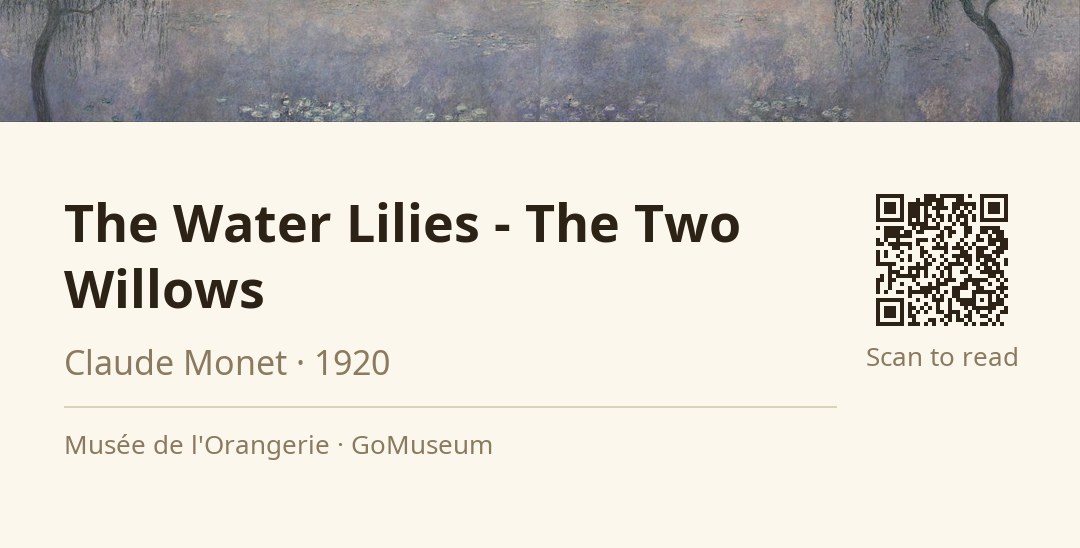
🎧 This work has audio narration — listen in the appTake a moment to really soak in the beauty of "The Water Lilies - The Two Willows" by Claude Monet. Notice how the two willows seem to cradle the tranquil pond, their branches almost whispering secrets to the water below. Look closely at the vibrant greens and soft blues—can you see how Monet captures the play of light dancing on the surface of the water?
These details matter because they reflect Monet's deep connection with nature and his innovative approach to painting. By focusing on the reflections and the interplay of colors, he invites you to experience the scene as he did, moment by moment, as the light shifts and changes. This was a hallmark of his Impressionist style, which sought to convey the essence of a moment rather than a detailed representation.
Created in 1920, this painting is part of a series that Monet dedicated to his beloved garden in Giverny, where he spent the last two decades of his life. It’s fascinating to think that even in his later years, Monet was still exploring new ways to express his vision of the world around him.
As you stand here, consider this: what emotions does this serene landscape evoke in you? What stories do you think these willows could tell if they could speak?
Oscar-Claude Monet, born on November 14, 1840, in Paris, was a pioneering French painter and a founder of Impressionism, a movement that transformed the art world. Raised in Le Havre, he developed a passion for nature and painting early on, encouraged by his mother, while his father hoped he would pursue a business career. After his mother's death in 1857, Monet moved in with his aunt, who supported his artistic ambitions.
Monet's career began with caricatures, but he soon sought formal training, studying under Eugène Boudin, who introduced him to plein air painting. His breakthrough came in 1866 with "La Femme à la robe verte," which garnered attention at the Salon. The term "Impressionism" originated from his work "Impression, Sunrise," exhibited in 1874, marking a shift away from traditional art.
Throughout his life, Monet focused on capturing the essence of light and color in nature, creating series of paintings that depicted the same scenes under varying conditions, such as his famous haystacks and water lilies. He settled in Giverny in 1883, where he cultivated a beautiful garden that became his muse. Despite personal hardships, including the loss of loved ones and health issues, Monet's relentless dedication to his craft solidified his place in art history as a master of modernism, influencing countless artists and leaving a lasting legacy. He died on December 5, 1926, in Giverny, celebrated as one of the most significant figures in art.
In 1920, Claude Monet, the renowned French painter and a pioneer of Impressionism, created 'The Water Lilies - The Two Willows.' This piece is part of a series that reflects his deep connection to nature, particularly the water lily pond he cultivated at his home in Giverny. Monet's late career was marked by a focus on capturing the ephemeral qualities of light and color, and this painting is no exception. It showcases his mastery of oil on canvas, measuring an impressive 197 by 1690 centimeters.
As you gaze at 'The Water Lilies - The Two Willows,' take a moment to appreciate Monet's masterful brushwork. Notice how he employs quick, fluid strokes to create a sense of movement on the water's surface, capturing the fleeting effects of light. The vibrant greens and soft blues are not merely colors; they are Monet's way of inviting you into a moment in time, where the reflections seem to shimmer and dance. The composition is carefully structured, with the two willows framing the pond, drawing your eye into the tranquil scene. Monet's choice of scale—nearly two meters wide—immerses you in the landscape, making you feel as though you could step right into his garden. This technique of painting en plein air allowed him to observe and replicate the ever-changing nature of light, resulting in a work that feels both spontaneous and deeply considered.
This painting, along with others in the water lilies series, helped cement Monet's legacy as a pioneer of Impressionism, influencing countless artists who followed. His innovative approach to capturing light and color laid the groundwork for modern art movements, encouraging artists to explore abstraction and personal expression. The emotional resonance of his work continues to inspire viewers and artists alike, reminding us of the beauty found in nature and the passage of time.
Did you know that Monet's fascination with water lilies was so profound that he spent the last two decades of his life painting them? But here's the twist: Monet was not just painting pretty flowers; he was experimenting with color and light in a way that was revolutionary for his time. He often painted the same scene multiple times, capturing the subtle changes in light and atmosphere. This relentless pursuit of capturing nature's beauty led to some of his most iconic works, including 'The Water Lilies - The Two Willows.'
Monet often painted the same scene multiple times to capture the changing light and seasons, and in this work, you can see how he applied quick, fluid brush strokes to convey the movement of water and the play of light, a technique that emphasizes the transient nature of the moment.