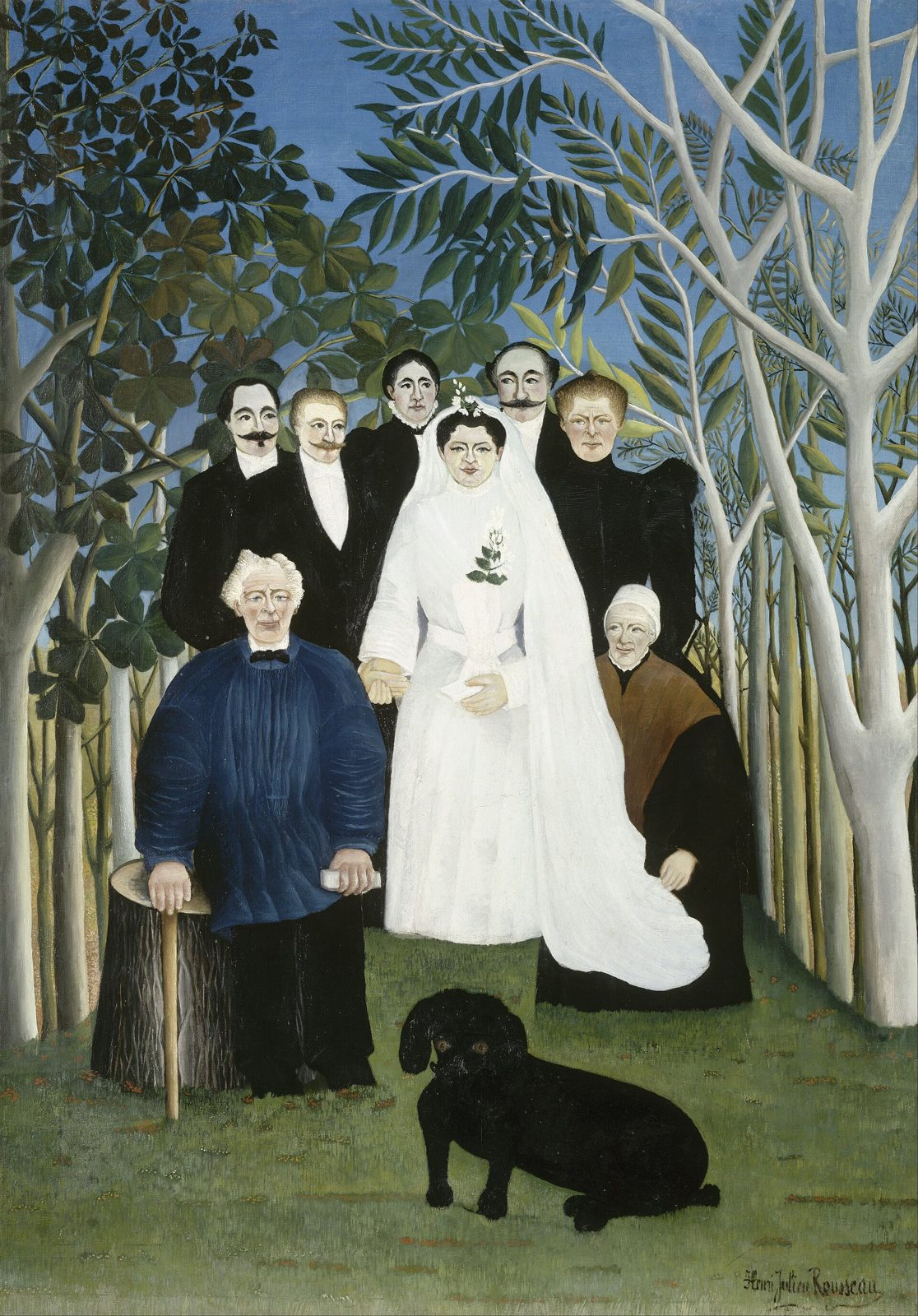
The Wedding Party
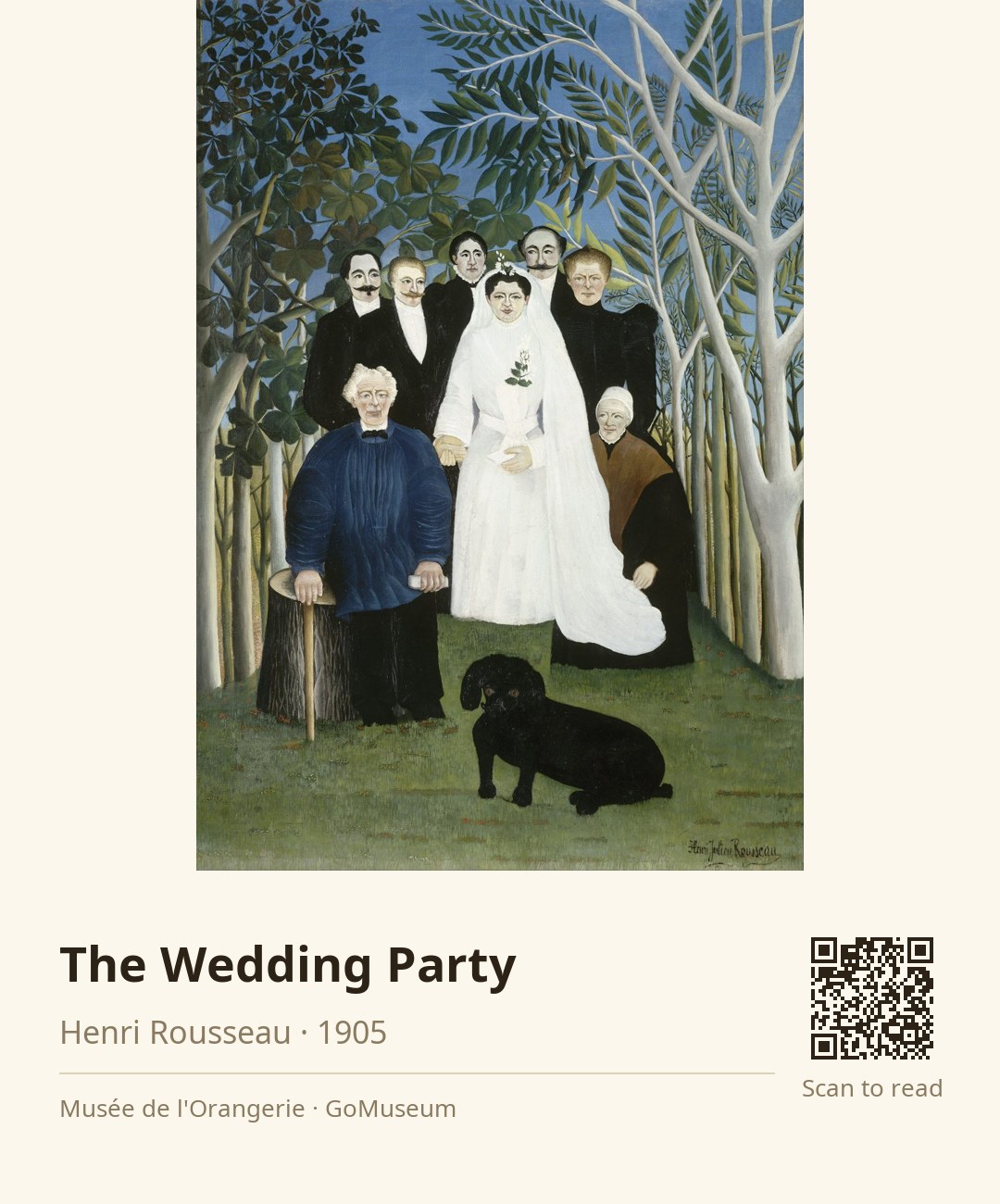
🎧 This work has audio narration — listen in the appTake a moment to really look at "The Wedding Party" by Henri Rousseau. Notice how the bride, dressed in her flowing white gown, seems to float above the ground, her veil intertwining with her grandmother's dress in a way that defies perspective. It’s almost as if time and space have twisted together in a playful dance.
This curious detail isn’t just a quirk; it’s a deliberate choice by Rousseau, who embraced a naive style that invites us to see the world through a child’s eyes, where the rules of reality can be bent. The oversized black dog in the foreground adds to this whimsical atmosphere, grounding the scene in a playful absurdity that challenges our expectations of a formal wedding portrait.
Painted in 1905, this piece reflects Rousseau's unique vision, one that was often misunderstood during his lifetime. He was a self-taught artist, drawing inspiration from the vibrant life around him, yet he never traveled beyond France. Instead, he transformed his observations into something fantastical, capturing the essence of joy and celebration in a way that feels both sincere and surreal.
As you stand here, think about the stories that unfold in this moment. What do you imagine the bride and her family are feeling? What memories might this scene evoke for you?
Henri Rousseau, born on May 21, 1844, in Laval, France, was a self-taught painter who became a pivotal figure in the Naïve art movement. Known as "Le Douanier" due to his job as a customs officer, he began painting seriously in his forties after a modest life marked by early hardship and family responsibilities. Despite facing ridicule from critics during his lifetime, Rousseau's unique style, characterized by vivid colors and dreamlike jungle scenes, garnered a devoted following.
His works, inspired by visits to the Natural History Museum and botanical gardens in Paris, often depicted fantastical landscapes, despite his never having traveled outside France. He exhibited regularly at the Salon des indépendants, where his painting "Surprised!" received acclaim from fellow artists, including Félix Vallotton. By the end of his life, Rousseau was celebrated by avant-garde figures like Pablo Picasso, who recognized his genius and honored him with a banquet in 1908.
Rousseau's influence on modern art is profound, impacting generations of artists, including the Surrealists and the Fauves. His legacy endures as a testament to the power of imagination and the beauty of simplicity in art. He passed away on September 2, 1910, in Paris, leaving behind a body of work that continues to inspire and captivate audiences worldwide.
Henri Rousseau's 'The Wedding Party' was painted in 1905 and has a fascinating history. This piece, like many of Rousseau's works, was initially met with skepticism and ridicule. Despite being a self-taught artist, Rousseau's unique style eventually gained recognition. The painting was displayed at the Salon des Indépendants, a venue known for showcasing avant-garde art. It was during this time that Rousseau's work began to attract a following, even though he often faced harsh criticism. The painting is now housed in the Musée de l'Orangerie in Paris, where it continues to be appreciated for its whimsical charm and naive style. The journey of this artwork from obscurity to a celebrated piece reflects the broader narrative of Rousseau's life and career, as he transitioned from a customs officer to a pivotal figure in the art world.
Take a closer look at the brushwork in 'The Wedding Party.' Rousseau's technique is both deliberate and instinctive, creating an almost dreamlike quality. The way he layers paint gives depth to the figures, while the vibrant colors evoke a sense of joy and celebration. Notice how the composition is structured; the bride floats above the ground, her veil merging with her grandmother's dress, creating a playful defiance of perspective. This choice draws you into the scene, inviting you to question the boundaries of reality. The oversized black dog in the foreground adds a touch of whimsy, grounding the surreal elements. The trees, with their stylized forms and improbable foliage, frame the group, enhancing the sense of a fantastical world. The intense blue sky contrasts beautifully with the warm ochre background, making the figures pop. Rousseau’s naive style, often dismissed as simplistic, actually showcases a sophisticated understanding of color and form, inviting viewers to see the world through a childlike lens.
One surprising tidbit about Rousseau is that he never traveled outside of France, yet he painted lush jungles and exotic scenes inspired by illustrated books and the botanical gardens in Paris. This ability to conjure vivid imagery from his imagination rather than direct experience adds an intriguing layer to his work, showcasing his remarkable creativity and the power of artistic vision.
Rousseau never traveled outside of France, yet he painted vibrant jungles and exotic scenes, drawing inspiration from illustrated books and the botanical gardens in Paris, showcasing his remarkable creativity.
Initially ridiculed for his naive style, Rousseau's work gained recognition over time, particularly after he began exhibiting at the Salon des Indépendants, where he eventually attracted a following despite early skepticism.
In 1908, Pablo Picasso hosted a banquet in Rousseau's honor, attended by many influential artists and writers, marking a significant moment in acknowledging Rousseau's impact on the avant-garde movement.