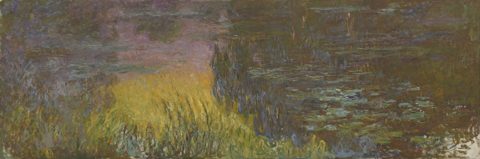
Morning with Willows
🎧 This work has audio narration — listen in the appThe pond in "Morning with Willows" reflects a serene world where water lilies float gently on the surface, surrounded by the delicate draping branches of willow trees. The soft blues, purples, and greens blend seamlessly, creating a tranquil atmosphere that invites you to pause and breathe. Monet's loose brushwork captures the play of light, making the water shimmer and dance, while the clusters of water lilies add a sense of depth and harmony to the scene.
This composition embodies Monet's lifelong fascination with nature and his desire to depict it as he perceived it, particularly through the lens of changing light and seasons. The willows, with their vertical lines, contrast beautifully against the horizontal expanse of the pond, emphasizing the peaceful coexistence of land and water. Monet often painted this water lily pond at his home in Giverny, where he dedicated years to cultivating the garden that inspired many of his masterpieces.
In 1914, Monet created this work during a period when he was increasingly focused on the effects of light and color, pushing the boundaries of Impressionism. His exploration of these themes would later influence generations of artists, solidifying his legacy as a pioneer of modern art.
Oscar-Claude Monet, born on November 14, 1840, in Paris, was a pioneering French painter and a founder of Impressionism, a movement that transformed the art world. Raised in Le Havre, he developed a passion for nature and painting early on, encouraged by his mother, while his father hoped he would pursue a business career. After his mother's death in 1857, Monet moved in with his aunt, who supported his artistic ambitions.
Monet's career began with caricatures, but he soon sought formal training, studying under Eugène Boudin, who introduced him to plein air painting. His breakthrough came in 1866 with "La Femme à la robe verte," which garnered attention at the Salon. The term "Impressionism" originated from his work "Impression, Sunrise," exhibited in 1874, marking a shift away from traditional art.
Throughout his life, Monet focused on capturing the essence of light and color in nature, creating series of paintings that depicted the same scenes under varying conditions, such as his famous haystacks and water lilies. He settled in Giverny in 1883, where he cultivated a beautiful garden that became his muse. Despite personal hardships, including the loss of loved ones and health issues, Monet's relentless dedication to his craft solidified his place in art history as a master of modernism, influencing countless artists and leaving a lasting legacy. He died on December 5, 1926, in Giverny, celebrated as one of the most significant figures in art.
Monet's technique in 'Morning with Willows' is a masterclass in the Impressionist style, characterized by loose brushwork that creates a sense of movement and fluidity. The application of paint is both spontaneous and deliberate, with layers of color blending seamlessly to evoke the shimmering surface of the pond. He employs a palette of soft blues, purples, and greens, which not only captures the tranquility of the scene but also reflects the changing light throughout the day. The composition is structured around the interplay between the vertical lines of the willow branches and the horizontal expanse of the water, drawing your eye across the canvas. Monet's choice to focus on the reflections in the water adds depth, inviting viewers to lose themselves in the serene landscape. The scale of the painting allows for an immersive experience, making you feel as if you could step right into the scene. This loose, expressive style was revolutionary at the time, pushing the boundaries of what painting could achieve.
Monet's garden in Giverny was a significant source of inspiration for many of his works, as he spent years cultivating it to create the ideal natural setting for his paintings.
Eugène Boudin was an artist who significantly influenced Monet by introducing him to plein air painting, which encouraged Monet to paint outdoors and capture the natural light and atmosphere.
Monet's practice of painting the same scene repeatedly allowed him to explore and document the variations in light and color throughout different times of the day and seasons, enriching his artistic expression.